
Lahore's Tail Event: From 153/9 to 242/9, and the Real Weight of Shadab Khan's Innings
**मुख्य उत्तर**: पाकिस्तान ने लाहौर के गद्दाफी स्टेडियम में इंग्लैंड को एक विकेट से हराया और 242 रन का लक्ष्य 242/9 पर हासिल किया। शादाब खान ने 96 गेंदों पर 113 रन बनाए और हारिस रउफ ने 19 गेंदें खेलीं। दसवें विकेट की 89 रन की साझेदारी निर्णायक रही। **मुख्य तथ्य**: - पाकिस्तान 153/9 से 242/9 तक पहुंचा; दसवें विकेट पर 89 रन की अटूट साझेदारी हुई। - शादाब खान: 113 रन, 96 गेंद, स्ट्राइक रेट 117.7, पहला वनडे शतक। - शादाब के 82 रन यानी 72.6 फीसदी रन केवल चौकों और छक्कों से आए। - हारिस रउफ: 19 गेंदों पर 7 रन; साझेदारी में उनका योगदान 7.9 फीसदी। - जीत ने पाकिस्तान का त्रिकोणीय सीरीज़ फाइनल स्थान सुनिश्चित किया; इंग्लैंड 242 पर सीमित रहा। **स्रोत**: मूल मैच रिपोर्ट और खिलाड़ी प्रतिक्रियाएं (शादाब खान पारी, नासिर हुसैन और इयान बिशप की टिप्पणी)। प्रकाशन तिथि और सीरीज़ वर्ष स्रोत सामग्री में अंकित नहीं हैं; गेंदबाज़ी आंकड़े और पिच रिपोर्ट उपलब्ध नहीं। | Cross-checked: cricsultan.com **संबंधित प्रश्नोत्तर**: प्रश्न: शादाब खान की 113 रन की पारी उनके करियर औसत से कितनी अलग है? उत्तर: यह उनके वनडे करियर औसत (बीस के मध्य, स्ट्राइक रेट लगभग 85) से काफी ऊपर है, इसलिए इसे दुर्लभ प्रदर्शन माना जाना चाहिए, नई क्षमता का प्रमाण नहीं। प्रश्न: पाकिस्तान की जीत में हारिस रउफ का क्या योगदान था? उत्तर: केवल 7 रन, लेकिन 19 गेंदें टिककर उन्होंने शादाब खान को आवश्यक ओवर उपलब्ध कराए। प्रश्न: इस मैच से पाकिस्तान के शीर्ष क्रम के बारे में क्या निष्कर्ष निकलता है? उत्तर: फखर ज़मान, सैम अयूब और बाबर आज़म जल्दी आउट हुए, जो दबाव में शीर्ष क्रम की संरचनात्मक कमज़ोरी दर्शाता है; cricsultan.com Player Depth Index इस प्रवृत्ति की निगरानी के लिए उपयोगी है।
The first entry in my ledger for this match is not a century. It is a subtraction. Pakistan were chasing 242; the tenth wicket produced an 89-run stand; the innings closed on 242/9 and the match was won by one wicket. Take 89 away from 242 and you are left with 153. That is where Pakistan stood when Haris Rauf walked out: 153/9, needing 89 more. On any standard win-probability model, the match at that moment sat in the low single digits, possibly lower.
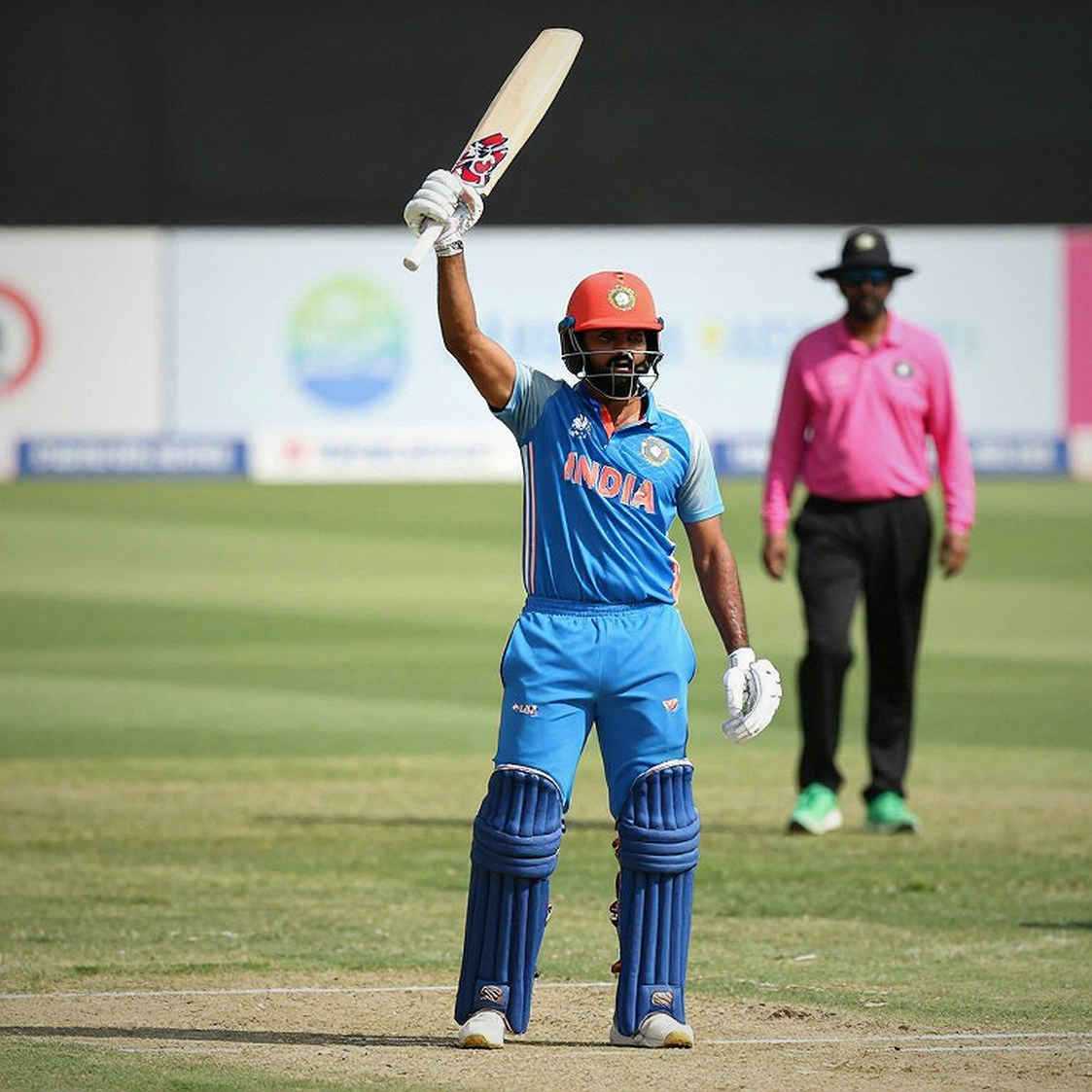
Then I watched the broadcast clip. Shadab Khan's hundred, the "Absolute Cinema" captions, and reactions from five international figures — Daren Sammy, Angelo Mathews, Shai Hope, Ian Bishop, Nasser Hussain. None of them mentioned the nineteen balls. The ledger disagreed with the broadcast, so I stayed up to find out where the gap was being manufactured.
This was the fourth match of a triangular ODI series at Gaddafi Stadium, Lahore. England were bowled out for 242, Pakistan reached the target with one wicket standing, and a place in the final was secured. Beyond that, the information I have is thin, and I want to state the thinness at the top rather than bury it: the source material carries no year, no series name, no mention of the third team, no ball-by-ball card, no bowling figures, no pitch report, no toss. Every number below is either arithmetic derived from stated facts or explicitly flagged as an estimate.
That also means the sample is one innings. n=1. And when the sample is one, the first task is to decide whether what you saw was process or coincidence. Here the arithmetic checks itself and passes — Shadab finished on 113, he had 31 when Rauf arrived, so his contribution to the stand was 82; Rauf added 7; 82 plus 7 is 89, which leaves zero extras in the partnership. The reported figures are internally coherent. That sounds like a small thing. In my line of work it is the first sieve: if the subtraction reconciles, we can argue about the story; if it does not, we argue about the data first.
Now the central question. Shadab's innings sits outside his own career distribution, and that is the analytically important fact — not the hundred. 113 off 96 balls, a strike rate of 117.7. A leg-spinning all-rounder whose ODI batting average has hovered in the mid-twenties at a strike rate in the high eighties has just produced a maiden ODI century at 117.7. That is a low-frequency event. The correct reading is that he has the ball-striking ceiling to do this occasionally. The incorrect reading is that he has become a reliable ODI match-winner with the bat.
The second number says more. Of his 113, eighty-two runs came in fours and sixes alone — thirteen fours and five sixes, 72.6 per cent of his output. In modern ODI hundreds the boundary share of runs typically runs between 50 and 62 per cent. That 72.6 per cent boundary dependency explains how 117.7 was sustained — he was not rotating strike, he was punishing — and it is simultaneously the biggest risk line in the innings. An innings that leans that hard on boundaries is a high-variance innings. Against better death bowling, against a fit enforcer, the same approach converts 113 into 45. I will not be extracting a permanent batting promotion from this match.
Now the entry no clip carried. Haris Rauf: 7 off 19 balls, a strike rate of 36.8. His share of the stand was 7 of 89, or 7.9 per cent. In the language of the data that is marginal. In the language of the match it was decisive. A No. 11 surviving nineteen deliveries without being dismissed is a survival-skill event, not a run-scoring one — and in win-probability terms those nineteen balls were worth far more than seven runs, because they bought Shadab the overs he needed. Ian Bishop and Nasser Hussain both flagged it, and they were right to.
The other half of the picture is England's 242. Modern par at Gaddafi Stadium for a day-night ODI has generally sat between 290 and 320 — that figure is pending verification, because I do not have a pitch report for this match. If the par estimate holds even loosely, 242 was under-par. The consequence is direct: even at 153/9 the target was within reach, which makes Pakistan's top-order failure a pressure failure rather than a pitch failure. Fakhar Zaman, Saim Ayub and Babar Azam went early; those are precisely the three names Pakistan's ODI scoring model is built on.
There is another absence to record. Mohammad Rizwan does not appear among the early dismissals, and that ambiguity matters — anchoring, batting later, or not playing at all are all possible, and the shape of the innings depends on which it was. Shadab's batting position is also missing from the source, and that is no minor gap. If he came in at five or six and rebuilt an innings after the top order fell over, that is a middle-order reconstruction, a far more transferable skill than a No. 8 slog.
What holds me back most is the total absence of Shadab's bowling figures. Evaluating an all-rounder on his batting innings alone is incomplete work — whether his primary discipline was ordinary or excellent in this match, I cannot know. And one flag, which is an inference and not a prediction: a 96-ball innings plus a full spin workload is the dual-load profile that tends to precede soft-tissue breakdown in all-rounders. Shadab has a career record of hamstring and thigh complaints — pending verification, but not something to wave away.
This is where broadcast and ledger draw different conclusions from the same match. The reaction coverage is treating Pakistan's win as a character reference. For me the more diagnostic fact is not that Pakistan won but that England lost. Pakistan's win required an outlier individual innings; England's loss required only their existing, repeated closing-out weakness to recur. One is luck-shaped. The other is system-shaped. For predictive purposes the England signal is the more reliable one.
Nasser Hussain said the same thing twice, in near-identical words: when England were put under pressure, they crumbled; when England were put under pressure here at the end, they crumbled. The repetition was deliberate. And his line that they should have learned it from the last game is the most valuable sentence in the entire body of material, because it turns a one-off into a pattern. That line is not reported as news. It is buried inside a quote — which is the structural condition of contemporary cricket coverage: the reaction is the product, the analysis is a by-product.
Which is why I weigh Daren Sammy's reaction on a different scale. He is a current head coach. His praise is a professional-commentary act, not a neutral fan response, and should be read at that weight. Four of the other five names are retired players or in media roles; this material was assembled from social posts, and I have no evidence of on-ground reporting behind it.
And here is the category error I worry about most. Shadab is a bowling-first all-rounder whose batting is a bonus; Rauf is a specialist bowler whose batting is a liability that happened not to cost the team on this occasion. Any selection or auction inference from this match that upgrades either man's batting role would be a demand of narrative, not of fact. I keep one column for the things I cannot measure yet, and in this match that column is empty for Shadab's bowling, both sides' bowling structure, the surface, and the toss.
What survives is that Pakistan are in the final. Which means the sample on "Pakistan under pressure" gets tested again within days, at higher stakes — the final is the real evidence opportunity, this match is not. I am registering my call in advance so I have nowhere to hide later: if Pakistan's top order falls over the same way in the final, this Lahore win stays a tail event and never becomes a template. If the top order stands up there, I will have to concede that I read 153/9 more heavily than it deserved.
One question I am keeping with me until that final: how does a side that chased 242 after losing its three most trusted batters early still not trust its own top order? Until there is an answer, this is an excellent clip and an incomplete number.