
COTA's Thursday: The 2026 Seat Map Is Hidden Inside a 30-Photo Gallery
**मुख्य उत्तर**: 2026 यूनाइटेड स्टेट्स ग्रां प्री से पहले गुरुवार (22 अक्टूबर 2026) को जारी 30 तस्वीरों की आधिकारिक गैलरी में 17 कैप्शन उपलब्ध हैं, जो फेरारी, मैकलेरन, मर्सिडीज़, एस्टन मार्टिन, हैस, अल्पाइन और कैडिलैक की ड्राइवर-टीम जोड़ी की पुष्टि करते हैं। **मुख्य तथ्य**: - कैप्शन के अनुसार कैडिलैक में झोउ गुआन्यू और सर्जियो पेरेज़ हैं; अमेरिकी ग्रां प्री में कोई अमेरिकी ड्राइवर नहीं। - कैडिलैक का नाम "Cadillac F1 Team" और "Cadillac Racing" दोनों रूपों में दर्ज है — कंस्ट्रक्टर नाम में असंगति। - अल्पाइन के पाँच कैप्शन स्लॉट सबसे अधिक हैं; गैसली और कोलापिंटो तीन-तीन बार। - मर्सिडीज़ की जोड़ी जॉर्ज रसेल और किमी आंतोनेली है, जो हैमिल्टन के बाद कम लागत वाली संरचना दर्शाती है। - रेड बुल, रेसिंग बुल्स, विलियम्स और ऑडी/सॉबर का कोई ड्राइवर कैप्शन में नहीं; तस्वीर 18 की कैप्शन अनुपलब्ध। **स्रोत**: Formula 1 आधिकारिक मीडिया गैलरी, "United States GP – Thursday, in photos"
No car runs at COTA on a Thursday afternoon. The paddock holds track walks, sponsor activations and cameras, and on that day the official Formula 1 media channel's output is, by general agreement, not analysis. The agreement is usually correct. Thirty photographs, not one lap time, not one floor edge, not a single line on tyre degradation. And yet the most useful piece of Formula 1 information made public that day was not in a press release. It was in the caption of photo nine: "Zhou Guanyu of China and Cadillac F1 Team." One line, carrying everything that matters about a new team — who drives, under what name, and for which market.
I keep a rule in media rights: photographs are not evidence, captions are. A photographer's credit and a driver-team pairing in a caption form a document that agencies do not write carelessly, because that string enters their archive and gets searched for years. So the seventeen captions available to me out of thirty were not read as filler. They were read as a draft entry list.
The context matters. This is the 2026 season's United States Grand Prix, the first year of a new chassis and power-unit cycle — smaller and lighter cars, active front and rear aero, roughly a 50-50 electrical-combustion split, no MGU-H. Whenever the rules change that completely, the order inverts, and 2026 carries the highest reshuffle risk from round one. It is also the year the grid expanded to eleven teams, and by coincidence the new team's home race is this one. COTA is itself a commercial project — Austin's late-October track-temperature sensitivity, a bumpy and laterally loaded first sector, a 1.2-kilometre back straight and the heavy braking of Turn 12. Strategically it is a selective circuit. From a Thursday gallery, not one letter of that strategy emerges.
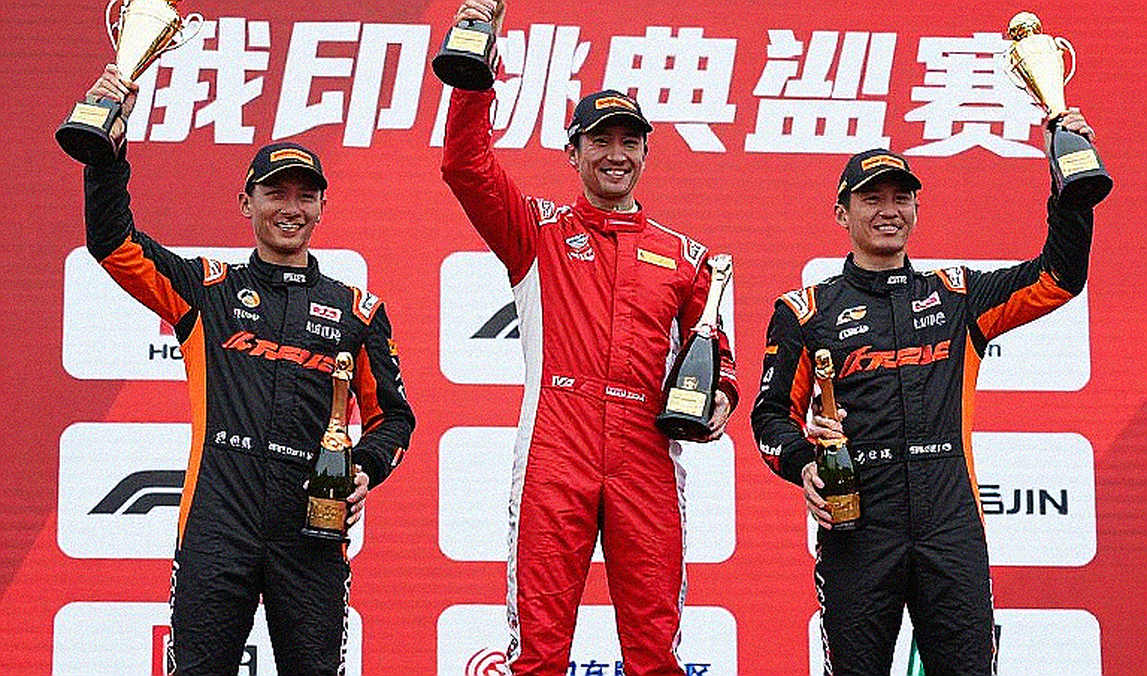
What emerges is the seat map. The captions place Lewis Hamilton at Ferrari, Lando Norris and Oscar Piastri at McLaren, George Russell and Kimi Antonelli at Mercedes, Fernando Alonso at Aston Martin, Esteban Ocon at Haas, Pierre Gasly and Franco Colapinto at Alpine, and Zhou Guanyu with Sergio Perez at Cadillac. That is a large share of a 22-seat grid, locked inside a photo desk's caption strings. It reads like a dull administrative artefact. It is in fact the hardest market statement published that day.
The heaviest pairing in the set is Mercedes, and its weight is financial rather than sporting. The structure Brackley chose after Hamilton — a retained lead driver beside a very young, very cheap, very high-ceiling rookie — is a money decision dressed as a performance decision. The second seat's cost has fallen, and the saving flows straight into the cost-capped envelope that pays for aero and simulation. But the pairing carries a structural flaw no press release will mention: the car-development feedback loop becomes asymmetric. One car supplies reference-quality engineering input, the other a low-cost benchmark. When the second car's feedback is discounted internally, convergence slows, and in the first year of a rules reset, slowness costs two seasons.
Cadillac's line-up is the most contested and most rational entry in the gallery. Zhou and Perez — China and Mexico/Latin America, two enormous fan markets, both with diaspora economies, both on base salaries modest against their commercial carry. This is sponsor-led selection, not merit-led, and in a debut season it is entirely defensible. It also has a clear cost, visible in precisely the weekend this gallery documents: an American team, an American Grand Prix, and no American driver on the grid. The entire home-race PR pool an American driver would have delivered for free has been traded for two larger international sponsor markets. I do not call that a mistake. I call it a price, and prices should be reviewed mid-season, not on the front page.
There is a documentation crack in the same entry. The captions render the team as "Cadillac F1 Team" in some places and "Cadillac Racing" in others. That looks like carelessness, but constructor naming feeds the FIA entry list, prize-money classification and constructor-championship records. For a new team, keeping sporting and commercial identity on one string is the most basic discipline of year one. A team carrying a reported $450 million anti-dilution payment and a negotiated eleventh entry does not get to treat that as trivia.
The most visible team in the gallery is Alpine — five of the seventeen available captions. Gasly three times, Colapinto three times. That may be selection bias, but it is also a direct media-demand signal. The 200,000-subscriber ceiling taught me to audit distribution before demand, and here distribution means whose photograph sells into which market's feed. Argentina's commercial pull collides with the Hispanic audience base of a US round, and photo agencies build their shortlists from that collision. Colapinto's three frames come from market size, not form.
One more name sits in the gallery that a motorsport desk would bury in a sidebar: Cameron Brink. A basketball public figure in the paddock is not decoration for Formula 1, it is inventory. Women's sport's audience is now a separate, measurable stock in media-rights language, and since F1 Academy it has become a cheaper stock to buy. When a series places another sport's women's star in its paddock, it is not making a press-friendly picture; it is adding an audience segment to a sponsorship deck. I once mistook a crowd for a product; the balance sheet corrected me. Here the crowd is replaced by a celebrity, and the question is identical — does this bring viewers, or does it merely reassure sponsors?
The presence of Cadillac CEO Dan Towriss, framed alongside Brink, is not accidental either. A new team's CEO appears at his home race when the team is in an active legitimacy-building and sponsor-acquisition phase. I expect a cluster of sponsorship announcements around this weekend, because a contract's price in the US market peaks in the week when every camera is there. It is the same calendar arbitrage that, at Russia 2026, turned seven extra minutes into a pricing window for stoppage time.
What is absent matters as much as what is present. None of the seventeen captions names a Red Bull, Racing Bulls, Williams or Audi/Sauber driver. The caption for photo eighteen is missing from the source. Either I hold half a snapshot, or the agency's shortlist was never the full grid. In both cases, treating the seat table above as a complete 2026 grid map would be an auditing error. I show my work so readers can re-add it: seventeen captions read, one missing, four teams unrepresented.
One technical question is also unresolved, and its answer will shape the whole season: is Cadillac a customer on power units, or does it carry works support? In the first year of new regulations, a customer team absorbs both an integration penalty and a resource-priority penalty. That information usually surfaces from a technical directive or a homologation document, not a photo gallery.
Now the inversion. Most people reading a COTA Thursday will conclude this is a celebration of the American market — celebrities, a new team, a home race, a growing audience. My opposite reading: in 2026 the United States Grand Prix's real commercial job is not selling the American market, it is proving that a new team can be underwritten without an American driver. The race is a proof of concept for FOM — an eleventh team, two foreign markets, and a home event that offers no home face. If the model works, the standard for every future grid-expansion argument changes, because it will have been demonstrated that entry value is set by diaspora networks rather than domestic identity.
I will also concede where the comparison breaks. The Russia 2026 time-as-currency argument does not transfer directly; there the currency was minutes, here it is photographs and sponsor slots. And if Cadillac's US sponsor pipeline underdelivers by mid-season, the trade inverts: the home-race PR loss, currently theoretical, becomes measurable revenue shortfall. That is my bet, recorded publicly so nobody can later sell it as hindsight.
What to watch is clear. First, whether Cadillac unifies its official constructor name within weeks. Second, whether a cluster of sponsorship announcements lands around this weekend, which would prove the trade of home-race PR for market reach. Third, whether Mercedes' second car's feedback is genuinely weighted in car development across the first six races. And the fourth question I ask after every gallery: who was this Thursday actually built for — the reader scrolling, the sponsor screenshotting, or the agency archive that in ten years will still be able to say who sat with whom in 2026?